DocsStart
Configuration
Kubernanny needs no configuration to run: install it, read the log, scan the code. Everything below is optional.
Helm values#
Chart: deploy/helm/kubernanny (OCI: oci://ghcr.io/kubernanny/charts/kubernanny).
| Value | Default | Effect |
|---|---|---|
clusterName |
homelab |
Shown in the app and every notification |
image.repository / image.tag |
ghcr.io/kubernanny/agent / appVersion |
|
publicUrl |
"" |
Address the app uses, for pairing links. Defaults to https://<ingress.host> when the ingress is on |
notifications.ntfyUrl |
"" |
ntfy topic URL |
notifications.webhookUrl |
"" |
Discord, Slack, Gotify or any JSON endpoint |
notifications.webhookFormat |
auto |
auto, discord, slack, gotify, json |
notifications.existingSecret |
"" |
Secret with NTFY_TOKEN and/or a secret WEBHOOK_URL; only these two keys are read, webhookUrl wins |
notifications.notifyAfterSeconds |
300 |
An issue must last this long before it is sent |
notifications.detail |
full |
minimal: only the cluster name and counts leave the cluster (for ntfy.sh and other public services) |
checks.intervalSeconds |
60 |
|
checks.certWarnDays / certCriticalDays |
14 / 3 |
|
checks.backupMaxAgeHours |
26 |
CNPG and Velero; critical at twice |
checks.disabled |
[] |
Modules switched off for good by id, e.g. [argocd, loki] (ids in CHECKS.md and COMPONENTS.md, e.g. rook-ceph, traefik, ingress-nginx, kyverno, gatekeeper, trivy, node-clocks, image-updates): not run, and no RBAC to read them. notifications switches all notifications off. The app cannot switch these on. |
actions.disabled |
[] |
Action types switched off for good: restart, argocd-sync, argocd-refresh, argocd-rollback, cnpg-backup, logs. A permission is dropped once no enabled action of an enabled module needs it (argocd-sync, argocd-refresh and an enabled argocd-rollback share theirs). |
actions.enabled |
[] |
Action types that are off until named here; only argocd-rollback: roll a manual-sync, single-source Argo CD app back to an earlier deployment from its history, from the Argo CD sheet, also when no issue is open (CHECKS.md). It adds no RBAC verb (the same patch as a sync) but renders an extra branch of the admission policy, and every rollback is announced. actions.disabled and rbac.allowActions: false win; the app can switch it off but never on. Any other id fails the install. Leave it empty unless you need it (SECURITY.md). |
checks.prometheusUrl / alertmanagerUrl |
"" |
Override discovery |
rbac.allowActions |
true |
false: no write verbs at all, actions answer 403 |
rbac.admissionPolicy.enabled |
true |
ValidatingAdmissionPolicies that limit the agent's write permissions to exactly what its actions change (the restart annotation, a plain Argo CD sync or refresh, with actions.enabled: [argocd-rollback] a sync to a revision from the app's history, a plain CNPG Backup). Needs Kubernetes 1.30+; on older clusters the chart notes say it is missing |
service.type / service.port |
ClusterIP / 80 |
|
ingress.enabled / className / host / annotations / tls |
off | Keep it on a VPN or behind SSO; see SECURITY.md |
serviceMonitor.enabled / interval |
off / 60s |
Prometheus Operator scrape of kubernanny_* |
networkPolicy.enabled |
false |
Ingress to 8080 only from networkPolicy.ingressControllerNamespace, to 9100 only from networkPolicy.monitoringNamespace |
networkPolicy.egress.enabled |
false |
Also restrict outbound: DNS, API server ports (apiServerPorts, default 443 and 6443), the monitoring namespace, HTTPS out (internetHttps) |
networkPolicy.egress.apiServerCIDRs |
[] |
The API server's CIDRs. Empty: the API-server ports (443, 6443) stay open to any address, so internetHttps: false alone does not block HTTPS out |
resources |
20m / 128Mi, limit 256Mi | Measured around 96 MB resident |
notifications.weeklyDigest |
enabled: false, weekday: 1, hour: 9 |
Weekly report through the configured channels (NOTIFICATIONS.md) |
timezone |
"" (UTC) |
TZ of the agent, for the weekly report, e.g. Europe/Berlin |
checks.systemNamespaces |
[] |
Namespaces the security posture check skips, on top of kube-system and the other system namespaces it knows |
vulnerabilities.enabled |
false |
Switches the vulnerabilities module on for this install: sends component package names and versions to api.osv.dev (or dbUrl). It only covers the Kubernetes version and 13 recognised components, not your own images; Trivy Operator in the cluster covers every image (the trivy integration reads its reports, on by default when found). The app can still switch it off; checks.disabled: [vulnerabilities] locks it off. See SECURITY-CHECKS.md |
vulnerabilities.dbUrl |
"" |
OSV-compatible mirror instead of https://api.osv.dev (https, or http to an in-cluster *.svc host) |
vulnerabilities.dbNamespace |
"" |
With networkPolicy.egress: namespace of that mirror. Empty: HTTPS to anywhere is allowed while the module is enabled |
vulnerabilities.allowAccept |
true |
false: nobody can mark an advisory as not applicable (built-in lookup and Trivy Operator findings); the API refuses (403 ACCEPT_LOCKED) before touching anything, and stored acceptances are ignored |
imageUpdates.enabled |
false |
Switches on the lookup of newer image tags at the registries (ENABLED_MODULES=image-updates); sends repository names only. The app can still switch it off; checks.disabled: [image-updates] locks it off. Adds an HTTPS egress rule when networkPolicy.egress.internetHttps is false |
language |
en |
en or de: notifications, the weekly report, the pairing banner in the pod log, and answers to callers that name no language. The app asks for its own UI language with every call. |
customComponents |
[] |
Your own applications as components: { name, images: [prefix], category, icon, description }, see CHECKS.md |
relay.enabled |
false |
Reach the agent from outside the VPN without an inbound port: one outbound WebSocket to the relay, which carries only end-to-end encrypted bytes (RELAY.md). Off: no outbound connection at all |
relay.url |
wss://relay.kubernanny.app |
The public relay, or your own (deploy/relay/, relay/cloudflare/) |
relay.egressPort |
443 |
Port for the NetworkPolicy egress rule to the relay |
notifications.appPush.enabled |
true |
Push straight to the Kubernanny app, sealed per device, through the relay and Firebase (NOTIFICATIONS.md). Nothing leaves until a device opts in, and that needs the relay. false (env APP_PUSH=off): the push routes answer 404, stored tokens are deleted on start, nothing is handed to the relay, the app shows it locked |
extraEnv, nodeSelector, tolerations, affinity |
Example for a VPN-only Traefik setup with cert-manager and ntfy:
clusterName: homelab
ingress:
  enabled: true
  className: traefik
  host: kubernanny.example.com
  annotations:
    cert-manager.io/cluster-issuer: letsencrypt-prod
    traefik.ingress.kubernetes.io/router.middlewares: kube-system-vpn-only@kubernetescrd
notifications:
  ntfyUrl: https://ntfy.sh/homelab-7f3a9c1e2b
serviceMonitor:
  enabled: true
Environment variables#
The chart sets these; set them yourself with deploy/install.yaml or docker run.
| Variable | Default | Effect |
|---|---|---|
CLUSTER_NAME |
cluster |
|
POD_NAMESPACE |
kubernanny |
Namespace of the agent's own Secrets kubernanny-identity and kubernanny-devices (from the downward API) |
INTERNAL_SOCKET |
/tmp/kubernanny.sock |
Unix socket of the internal API (end-to-end calls, admin CLI). At most 100 bytes. |
PULSE_TOKEN |
Removed in 0.3: the agent refuses to start while it is set. Devices pair with their own keys. | |
PUBLIC_URL |
For pairing links and ntfy's click action | |
PORT |
8080 |
API and web UI |
METRICS_PORT |
9100 |
0 disables /metrics |
WEB_ROOT |
/app/web in the image |
Directory of the web build; unset: API only |
CHECK_INTERVAL_SECONDS |
60 |
|
NOTIFY_AFTER_SECONDS |
300 |
|
NTFY_URL, NTFY_TOKEN |
HTTPS, or HTTP only to an in-cluster *.svc host; the agent refuses to start otherwise |
|
WEBHOOK_URL, WEBHOOK_FORMAT |
auto |
same rule |
NOTIFY_DETAIL |
full |
minimal: no names, hosts or messages in notifications |
CERT_WARN_DAYS, CERT_CRITICAL_DAYS |
14, 3 |
|
BACKUP_MAX_AGE_HOURS |
26 |
|
DISABLED_MODULES |
Comma-separated module ids switched off in the deployment (DISABLED_CHECKS, the name before 0.3, still works). The chart sets it from checks.disabled. |
|
DIGEST, DIGEST_WEEKDAY, DIGEST_HOUR |
off, 1, 9 | DIGEST=weekly turns the weekly report on |
TZ |
UTC | Time zone of the agent |
ENABLED_MODULES |
Comma-separated modules that are off by default (vulnerabilities), switched on for this install. The chart sets it from vulnerabilities.enabled. |
|
VULN_DB_URL |
https://api.osv.dev |
OSV-compatible vulnerability database; https, or http only to an in-cluster *.svc host |
SECURITY_SYSTEM_NAMESPACES |
Comma-separated namespaces the security posture check skips, in addition to the built-in ones | |
LANGUAGE |
en |
en or de, see the Helm value language. glibc uses the same variable as a list (de_DE:en): the first entry counts; anything unknown means English. |
UPTIME_KUMA_STATUS_PAGE |
Slug of a published Uptime Kuma status page (letters, digits, dashes). The uptime-kuma module then reads its monitors; without it only the pods are checked. Helm: extraEnv: [{ name: UPTIME_KUMA_STATUS_PAGE, value: homelab }]. In demo mode it defaults to homelab. |
|
RELAY_URL |
wss:// relay address (ws:// only for localhost or an in-cluster *.svc host). Unset: no outbound connection. The chart sets it from relay.enabled / relay.url. The relay's own settings (limits, TRUST_PROXY) are in RELAY.md. |
|
APP_PUSH |
on |
off disables native push for good (Helm notifications.appPush.enabled) |
CUSTOM_COMPONENTS |
JSON array of your own components (the chart sets it from customComponents) |
|
DISABLED_ACTIONS |
Comma-separated action types switched off in the deployment. The chart sets it from actions.disabled, plus every write action without rbac.allowActions. |
|
ENABLED_ACTIONS |
Comma-separated opt-in action types (only argocd-rollback); the chart sets it from actions.enabled. Anything else stops the start. DISABLED_ACTIONS wins. In demo mode argocd-rollback is on. |
|
PROMETHEUS_URL, ALERTMANAGER_URL |
Override discovery | |
CORS_ORIGINS |
Capacitor, Ionic and localhost dev origins | Comma-separated; the web UI served by the agent needs none |
PAIRING_LOG |
true |
false: no pairing banner in the log |
POD_NAME |
(the chart sets it) | The holder name in the Lease that decides which pod notifies, runs actions and holds the relay during a rolling update. Unset (outside a pod): always in charge, no Lease |
LEASE_NAME |
kubernanny |
Name of that Lease in the agent's namespace (the Role grants exactly this name) |
SHUTDOWN_DELAY_SECONDS |
5 |
After SIGTERM: unready and handed over at once, but still answering this long while the endpoints are removed; then requests in flight get up to 10 s |
READY_TIMEOUT_SECONDS |
90 |
/readyz turns ready after the first check run, or after this long without one |
NODE_EXTRA_CA_CERTS |
ServiceAccount CA (chart) | Lets Node trust the API server |
DEMO |
Built-in demo cluster, every device counts as paired and any pairing code works: broken, warning, healthy, 1 or true (= broken) turn it on; unset, empty, 0, false or off turn it off; any other value stops the agent at start |
|
K8S_API_URL, K8S_TOKEN |
Development outside a cluster, e.g. kubectl proxy on http://127.0.0.1:8001 |
Invalid values fail the start with a clear message instead of running with a surprise: unknown ids in DISABLED_MODULES / DISABLED_ACTIONS, any id in ENABLED_ACTIONS other than argocd-rollback (the chart also refuses unknown ids in checks.disabled / actions.disabled / actions.enabled), and any unrecognised value of VULN_ACCEPT, NOTIFY_DETAIL, WEBHOOK_FORMAT, DIGEST, PAIRING_LOG, METRICS_PORT, APP_PUSH or DEMO. DIGEST_WEEKDAY takes 0 to 6 and DIGEST_HOUR 0 to 23. checks.disabled: [prometheus] means no Prometheus request at all, from any module.
The app#
Per cluster the app stores a name, the agent address and the agent's public key with Capacitor Preferences (UserDefaults on iOS, SharedPreferences on Android, localStorage on the web). This device's private key goes to the iOS Keychain or the Android Keystore (@aparajita/capacitor-secure-storage, "this device only"); on the web to the origin's storage. Keys stored by earlier versions are moved there on the first start. It polls every 30 seconds while in the foreground. Light and dark mode follow the system.
Switches in the app#
flowchart LR
  helm["Helm values<br/>checks.disabled, actions.disabled,<br/>actions.enabled, rbac.allowActions"] -->|"sets env and RBAC"| agent["agent"]
  app["App: What is checked"] -->|"writes ConfigMap<br/>kubernanny-settings"| agent
  agent -->|"runs a module or action only if<br/>both allow it"| run["checks and actions"]
  helm -. "locked rows" .-> app
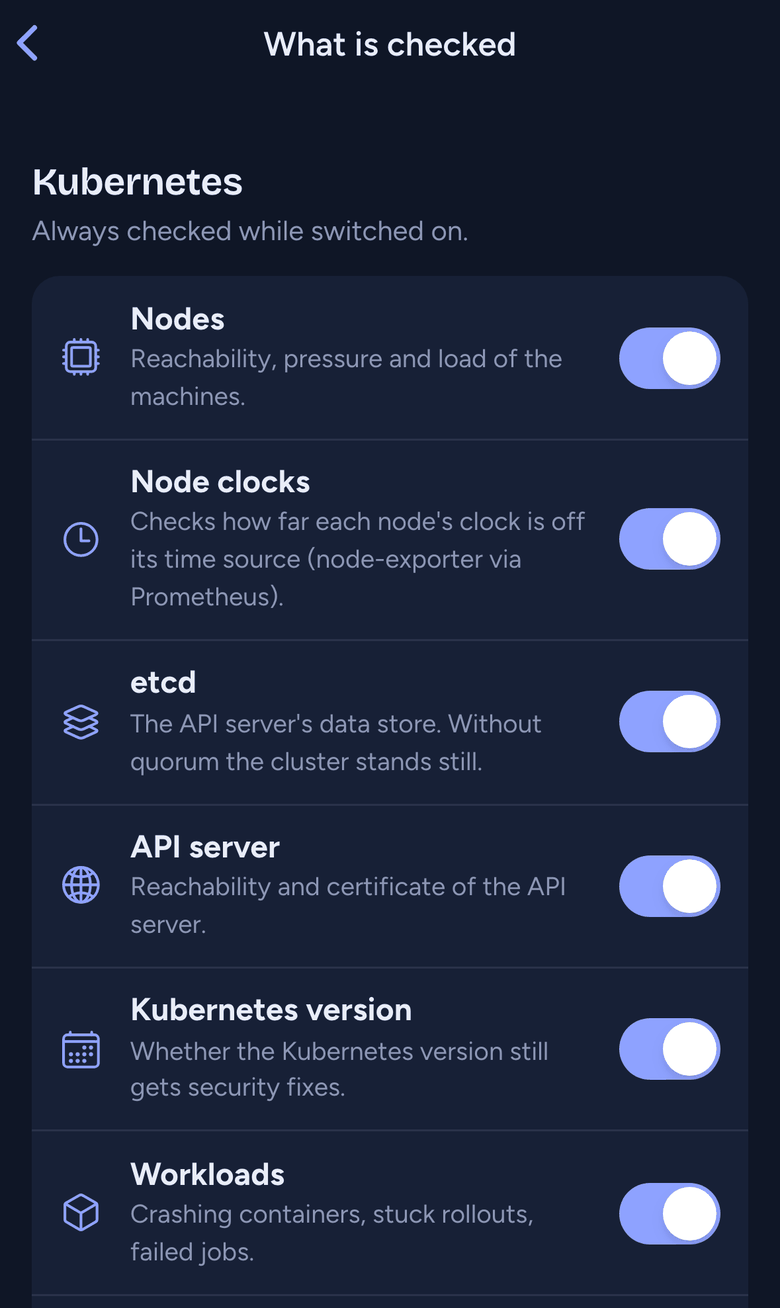
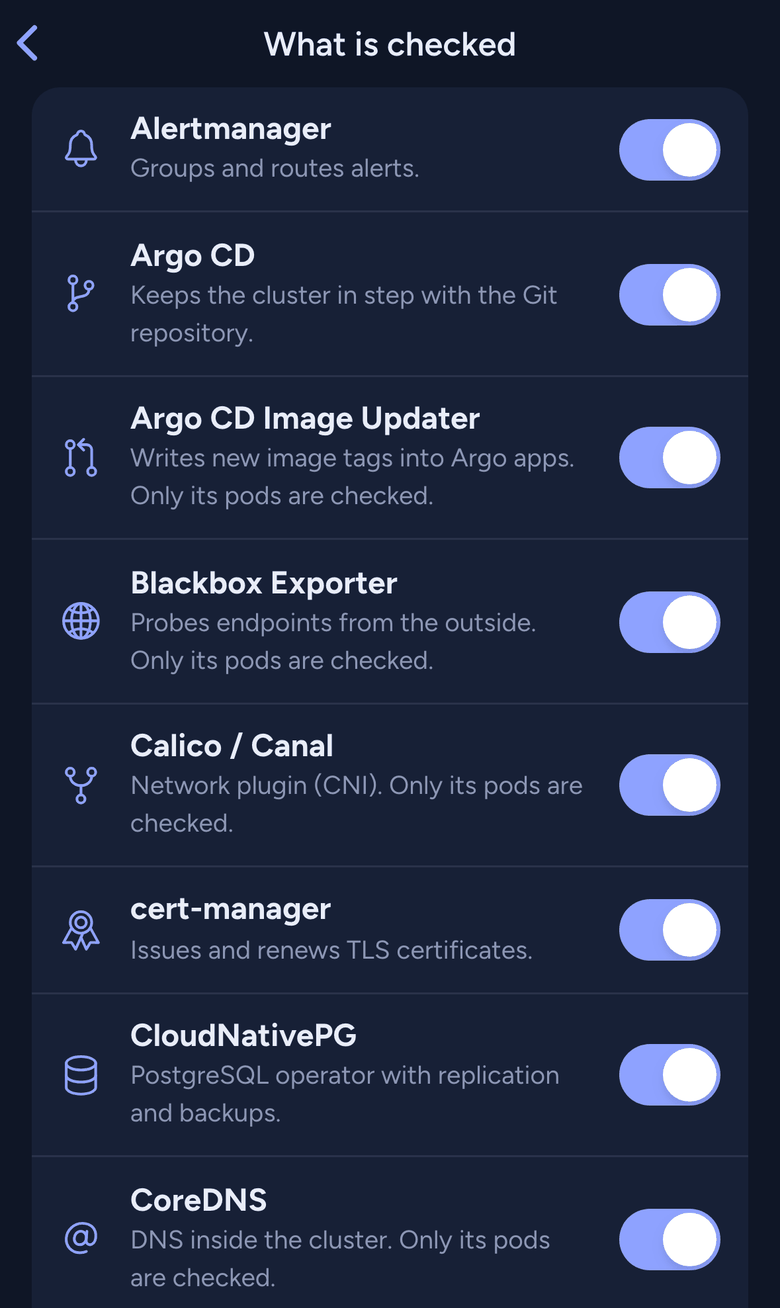
The app's switches: every check, tool and action type.
Two layers. The Helm values are hard: what they switch off is not run and, for integrations and actions, not even permitted by RBAC, and the app shows it locked. The app's switches are soft: they stop the agent from using something the RBAC still allows, and anyone with a paired device can flip them back.
Cluster settings → "What is checked" lists every core check, every recognised component, the action types and notifications, each with a switch. Switches set in the app are stored in the ConfigMap kubernanny-settings in the agent's namespace and survive restarts; anything switched off in the Helm values shows as locked. Known vulnerabilities is off until switched on; its row says what it would send and where. kubectl -n kubernanny delete configmap kubernanny-settings resets the app's switches.